Showing posts with label iPad Air and mini. Show all posts

JD Power Explains Why Samsung Beat Apple In Its Latest Tablet Study: Price

Yesterday, JD Power released its newest tablet satisfaction study and the Internet went a bit nuts. For the first time, Samsung had edged  out perennial favorite Apple in customer satisfaction on tablets.

This was a stark change from volume one of the study which had Apple handily beating its competitors.

There was outcry about how close it was, about how the JD Power chart and scoring (835 to Samsung, 833 to Apple) simply didn’t add up. I have to admit, I was fairly curious about that, and supposed that it had to be about price.

So I reached out to JD Power and spoke to Kirk Parsons, senior director of telecommunications services. What he told us wasn’t too surprising, but it may help clear up some of the confusion.

First off, the “power circle” chart that’s being widely circulated is simply a visual tool, and not representative of the actual scores given to the brands evaluated in its survey.

The power circle chart showed Apple winning handily in four categories, including performance, ease of use, physical design and tablet features.

Only one category showed a clear win for Samsung: cost. But most folks were a bit skeptical, considering that the JD Power report only weights cost as 16 percent of the overall score.
Parsons confirmed the percentage, but said that the differential between the price category scores of the iPad and the score of the Samsung tablets that were included in the survey was large enough to “more than offset” the score in the other four categories.

Parsons says that the price category contributed to a full two-point difference between Apple and Samsung.

For reference, here are the manufacturer’s suggested retail prices of Samsung tablets released in the last year, the range covered by the study:
  1. Galaxy Note 10.1 16GB – $499
  2. Galaxy Note 10.1 32GB – $549
  3. Galaxy Note 10.1 (2014 Edition), 16GB – $549
  4. Galaxy Note 10.1 (2014 Edition), 32GB – $599
  5. Nexus 10 32GB – $499
  6. Galaxy Tab 3 10.1 – $399
  7. Galaxy Note 8.0 – $399
  8. Nexus 10 16GB – $399
  9. Galaxy Tab 3 8.0 – $299
  10. Galaxy Tab 3 7.0 – $199
And here are Apple’s iPad prices:

  1. iPad mini 16GB – $329
  2. iPad mini 32GB – $429
  3. iPad mini 16GB – $529
  4. iPad 2 16GB $399
  5. iPad 16GB $499
  6. iPad 32GB $599
  7. iPad 64GB $699
Note that Apple charges around $100 to double the memory of the model below, while Samsung only charges $50. Samsung also offers tablets both right above and below Apple’s non-Retina iPad mini, which was only just reduced to $299. Note, too, that the study was conducted on devices released within the last year only, so the long-term usefulness of said devices really wasn’t in play here.

All of the above prices are MSRP, and many have been reduced at the retailers. Apple rarely discounts its tablets aside from limited promotions or yearly drops, but some retailers offer discounts.

Parsons declined to share the exact price ranges of the tablets included in the study. Of note: Apple also scored the same two power circles on the first study earlier this year, which it aced, and which applied the same metrics and questions.

So purely according to the JD Power study if you want the best performance, ease of use, physical design and “tablet features,” then the iPad is probably the way to go. But if you’d like to stretch your dollar as far as it can go, the Samsung lineup offers more value. (Yoogle) (Techcrunch) (GNN)

Additional reporting on this story by Chris Velazco

iPad Air review

The arrival of its mini brother has meant that the iPad 'maxi' lost some of its headline billing but Apple has taken the bigger tablet back to the drawing board, given it a fresh new name iPad Air and is hoping to prove that not everyone wants to give up on a bigger screen.

As well as improvements to its innards, in a new A7 chip and camera upgrades, the decrease in thickness and weight in the new iPad Air is very welcome, making what could have been an incremental upgrade hugely significant.

The iPad Air weighs in at just 1lb (or 453g) and 7.5mm thick - a significant step up from its predecessor, and in the hand that difference is genuinely startling.
The fourth incarnation of the iPad came quickly after the third - both announced last year, which may well have lessened the impact (especially given the rowdy newcomer it was announced alongside).
This time around, the iPad Air is looking to make a splash and to that end we get refreshed innards that take this a big step towards being a fully-functioning PC with the integration of Apple's latest physical technology.

Chipping it in

Under the hood, the iPad 5 has the 64-bit architecture of the A7 chip that debuted in the flagship iPhone 5S, but as a bigger device that power is even more important here, described by Phil Schiller on stage as 'screamingly fast'

The gap between tablets and laptops has not just narrowed but all but disappeared, and the advancements made by Apple in this area are key to its success.
Also improved are the cameras bringing a HD Facetime camera (ie the front one) and a 5MP, 1080p rear camera. Don't use the rear one, though. Seriously. Don't be that person.

The cameras appeared to function pretty well in the low light of the hands-on room, but we need to get it out into the wild to give you a proper opinion.

They are certainly an improvement on the iPad 4, but beyond that it's really too early to say. Although it doesn't matter as you shouldn't use the rear one. Have we mentioned that?

Past wins

Sometimes in the wash of new technology it's easy to forget what the iPad already brings so it's important to note that the arrival of iOS 7 just a few weeks ago have made significant improvements to the iPad universe already, bringing a welcome step away from skeuomorphism and a more modern and fresh design.

And that Retina screen that has been wowing us from last year is still present and correct and, as you would expect from a tablet central to everything that is great about the iPad.
The display is crisp and colourful, meaning that photographs are vibrant and sharp, web surfing is clear and easy and watching films is a joy.

There's no Touch ID which is a surprise given that it's quickly become a nice feature of the iPhone 5S and the A7 chip can handle it but it's not by any means critical, and we'll merrily take the reduction in size and weight.

As you would expect with this level of power, the apps run superbly and we were flicking in and out of things like the App Store and iWorks apps without any sign of slowdown or hesitance.
For many 64-bit architecture on an iPhone was unnecessary but, when it comes to the iPad, the extra oomph is a real joy, and we're hoping that developers can take real advantage of the step up.
More than a name

The iPad Air is much, much more than just a name change the reduction in the size and weight of the device improve it on a fundamental level.

The biggest criticism you could level at the iPad 4 was its size and weight, and the Air's biggest difference is that it's simply more of a pleasure to hold.

It's now down to less than the Sony Xperia Tablet Z, and we were amazed at how easy that was to hold but Apple has taken things to another level now.
The innards and the other improvements are nice, incremental of course, but all make for a fine device.

Early verdict

It's hard to put into words how much Apple has improved the iPad, offering a stunning level of detail and power with a build quality that's unrivalled.

But the reduction in thickness, and especially weight could well ensure that the iPad Air is the finest tablet on the market.

It will always have its detractors, but in the tablet market at least Apple is making no compromises it's level on price for the most part, and if it had a microSD card slot, then the critics would probably have nothing to say at all.

We can't wait to get our hands on one for longer and really put it through its paces stick around for our in depth review, which we'll bring you in the very near future,

Apple's new iPad Air and mini: key facts and features

Apple unveiled its new iPad, named the iPad Air, as well as an updated iPad Mini and updated MacBook Pros, at an event in California.Apple has announced its latest slew of product updates in anticipation of the Christmas rush. Here's what you need to know.

IPad Air

The new iPad is just 7.5mm thick and weighs 454g, making it the thinnest and lightest full-sized iPad to date. It is called the iPad Air.

The 64-bit A7 processor in the iPad Air has double the performance of the previous generation and adds performance and security benefits, along with potential reductions in complexity of both hardware and software, which should aid reliability.

The iPad Air will cost £399 ($499) and upwards, with the 4G version starting at £499 ($629). They will be available from 1 November.

IPad mini

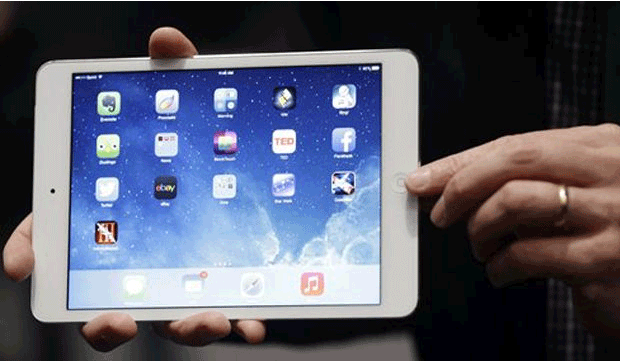
The iPad mini stays the same size as the previous generation, but receives the retina display and A7 processor of its bigger sibling.

As a result, the new iPad mini costs more than its predecessor, from £319 ($399), with the 4G version starting at £419 ($529). They are also available in November, but an exact shipping date has not been confirmed.

At the low end, both the iPad 2 and the original iPad mini stay in the line-up. The iPad 2 will sell for £329 ($399), and the original iPad mini gets a price cut down to £249 ($299).

MacBook Pro

Also unveiled were new MacBook Pros. The 13-inch model now weighs 1.5kg and is 1.8cm thick, and has been fitted out with Intel's Haswell CPUs and Iris integrated graphics.

The 15-inch MacBook Pro stays the same on the outside, but also gets a speed bump to Intel's "Crystalwell" CPU and Iris Pro graphics, as well as an Nvidia GeForce GT750M for gaming.

Both laptops have longer-lasting batteries, with the 13in increasing from 7 hours to 9 hours, and the 15in increasing from 7 to 8 hours.

The 13in MacBook Pro will retail from £1,099 ($1,299), and the 15in will retail from £1,699 ($1,999). They are available from today.

Mac Pro

The Mac Pro, which was first announced in July and has been teased since 2012, was given a shipping date: December. It will retail for £2,499 ($2,999).
Mavericks, iWork and iLife

Apple's operating system, Mavericks, is available free for anyone with a compatible Mac.
The OS works with iMacs and MacBook Pros from 2007, with MacBook Airs, MacBooks and Mac Pros from 2008, and with the Mac Mini from 2009.

Additionally, its iWork productivity suite and its iLife media suite are both available for free with any new Mac or iOS device.