(GNN) - It is hot take season today on the net neutrality front, and TechCrunch would be remiss if we didn’t bring you the best, worst, banal, and asinine of the virulent anger and relieved happiness that is currently bouncing around the nation.
What we’ve done is put our ears to several groaning inboxes, and have selected a number of letters, responses, quotes, and oral comments from the day, and thrown them into this post. Think of it as a hot take gumbo of sorts.
The FCC
First up, the FCC. We’ll give Commissioner Ajit Pai first words, since he left so many behind this morning:
To put it another way, Title II is not just a solution in search of a problem—it’s a government solution that creates a real-world problem. This is not what the Internet needs, and it’s not what the American people want.
Keeping on the no side of things, here’s Commissioner Michael O’Rielly:
While I see no need for net neutrality rules, I am far more troubled by the dangerous course that the Commission is now charting on Title II and the consequences it will have for broadband investment, edge providers, and consumers.
We agree with the commissioner: If one did feel that net neutrality regulations were unneeded, what Chairman Wheeler got passed today would be in fact both belt and suspenders, but in reverse.
Moving from nay to aye, here’s Commissioner Jessica Rosenworcel:
This is a big deal. What is also a big deal is 4 million voices. Four million Americans wrote this agency to make known their ideas, thoughts, and deeply-held opinions about Internet openness. […] That might be messy, but whatever our disagreements on network neutrality are, I hope we can agree that’s democracy in action and something we can all support.
And finally, FCC Chairman Tom Wheeler:
The American people reasonably expect and deserve an Internet that is fast, fair, and open. Today they get what they deserve: strong, enforceable rules that will ensure the Internet remains open, now and in the future.
The ISPs
To the shock of none, ISPs are not happy with how the vote went down. All that good lobbying spend, noodled away by a party-line vote.
We’ll start with Comcast, promising incoming legal recourse:
We are disappointed the Commission chose this route, which is certain to lead to years of litigation and regulatory uncertainty and may greatly harm investment and innovation, when the use of Section 706 alone would have provided a much more certain and legally sustainable path.
That bit underscores the fact that the FCC had best draw the moat and sink the bailey when it comes to the coming legal tussle over its regulatory authority in the matter.
Verizon took a whimsical approach, putting its complaint in
morse code:
See that little tag at the bottom? That’s some new-school style shade. Here’s the key excerpt:
-.. .. -.. / -.– — ..- / .-. . .- .-.. .-.. -.– / – .-. .- -. … .-.. .- – . / – …. .. … ..–..
From the group’s name alone, Broadband for America, can you guess what their take was on the vote? Surprise!
The FCC’s decision to impose obsolete telephone-era regulations on the high-speed Internet is one giant step backwards for America’s broadband networks and everyone who depends upon them. […]
There is only one solution: now is the time for Congress to act, to enshrine the Open Internet into law, end the gamesmanship, and secure America’s continued leadership in the global Internet economy.
I am not sure how efficacious calling for Congressional action is at the moment, but there you have it.
A House Divided
A group of 21 House Republicans, lead by Judiciary Committee Chairman Bob Goodlatte, wrote a letter to FCC Chairman Tom Wheeler saying, “We will not stand by idly as the White House, using the FCC, attempts to advance rules that imperil the future of the Internet.” The document also contained threats of legislation to strip the FCC of its regulatory authority in the matter.
On the other side of the fence, Democratic Rep. Zoe Lofgren called the vote a “victory for a free and open [I]nternet.” She continued later in the comment:
These new protections, including reclassification of broadband services under Title II authority, will likely face years of litigation by incumbent telecom and cable opponents. However, I am convinced that these rules comprise the strongest approach to preserving and guarding the internet as we know it.
Both sides, then, are willing to discuss litigation openly. I honestly wonder which side is being cocky without merit, and which is being cocky with merit, when it comes down to a potential future winner.
Sprint, Netflix and Mozilla
That Netflix likes the rules is roughly as surprising as spoiled milk in a desert. The digital video and television company said the following in a statement:
The net neutrality debate is about who picks winners and losers online: Internet service providers or consumers. Today, the FCC settled it: Consumers win.
Next up, another ally: Sprint. Sprint said that it has “been a leader in supporting an open Internet,” and that its corporate soul “commends the FCC for its hard work in arriving at a thoughtful, measured approach on this important issue.” So the inclusion of wireless under net neutrality doesn’t have this carrier worrying too much.
Finally, Mozilla called the vote an “important victory for the world’s largest public resource, the open Web.”
Other Voices
- The American Association of Independent Music thanks Chairman Wheeler in a statement, noting that the rules applying to “lawful content.” The group also praised the use of Title II, saying that it will “prohibit providers from favoring content distributed by the largest companies with the deepest pockets.”
- The American Library Association, calling itself a “longtime network neutrality advocate,” said that the FCC’s vote today is a “bold step forward in ensuring a fair and open Internet.”
- Senator Al Franken had something to say: “I’m thrilled that the FCC has taken this crucial step. But the fight isn’t over as some Republicans are already working on legislation to undo all of this. So in the weeks and months ahead, I will continue to make sure everyone understands what’s at stake, and why we need to stand by the strong rules adopted by the FCC.”
- The League of United Latin American Citizens argued that today’s action by the FCC “will not help low income, Latino and other minority communities in their quest to get online nor will it prevent ISPs from charging consumers for faster speeds.” The group called for the FCC to “return to [the] imperative of eliminating the digital divide among minority and other disadvantage populations.”
- The Discovery Institute, which peddles creationism under the guise of intelligent design, is not a fan of the vote: “Today’s party-line vote by the Federal Communications Commission to reverse three decades of bipartisan communications policy threatens to jeopardize investment and innovation in the network by opening the door to the possibility of pervasive regulation,” said the group’s Hance Haney.
- The National Venture Capital Association was in favor of the vote, which doesn’t surprise, given that it likely doesn’t fund too many new ISPs. But its members likely do pour capital into companies that ISPs would have liked to charge for faster access to end-consumers. Here’s the group: “Today’s vote is a win for the entrepreneurial ecosystem. By prohibiting ISPs from discriminating through paid prioritization, the FCC has ensured that America’s startups have the opportunity to thrive and grow on a level playing field without being placed at a competitive disadvantage to larger competitors.”
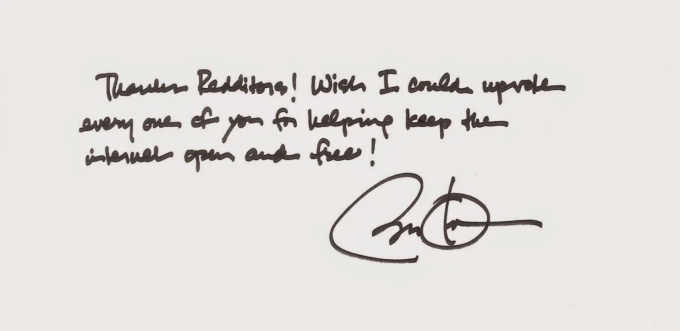
- And finally a note to the Reddit community from President Obama:
We could go on, but you get the gist. In short, everyone who was in favor of net neutrality before the vote still is, and those who weren’t, still aren’t. Alert the media.


